
by Troy Bishopp
Truth be told; biodiversity is worth more than gold. However, defining and measuring its true value is still a moving target even with all the fancy, dancy, AI tools we have in 2026.

After sifting through some old grazing articles, I found one of my favorite pieces authored by New Zealand’s, Holistic Management Educator and Author, John King, who took on the “Economics of Biodiversity” in an ACRES-USA 2010 edition. With significant input costs increasing for farmers lately, it seemed like a pertinent subject to focus on. If nature provides fertility and ecosystem services through its diverse, biological systems can we get onboard with our enhanced management? And will it reduce the effect oil derivatives have on our resiliency?
It’s also another way to feel good, going into spring pasture season, because with each acre of healthy soil and sod, there’s biological capital you can take to the proverbial bank, even though they probably won’t trade you for gold.
King asked a reasonable question to consider, “What is the immediate market value of the pastoral biodiversity that contributes to farm production?” One simple way he surmised, “was to relate this biodiversity to its immediate market value through the price of fertilizer.”
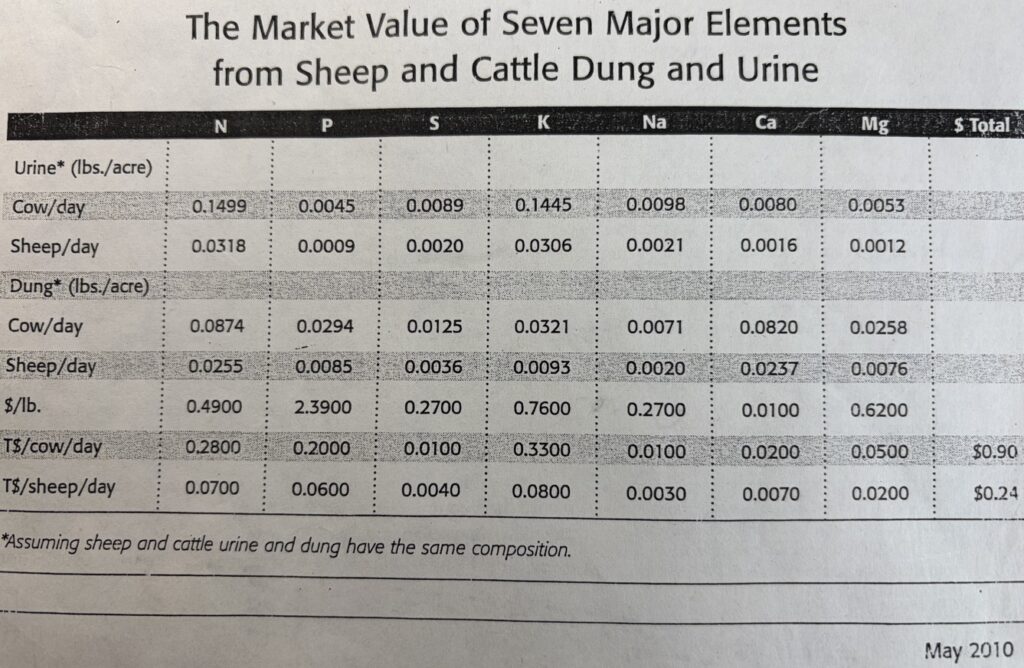
He didn’t take this topic on alone. He leaned on the work of David Charles Whitehead who authored the book “Nutrient Elements in Grassland: Soil-plant-animal Relationships” which highlights the role of ruminates on grasslands and the capital generated naturally by the cooperation of plants, animals and the underground livestock. King based his answers on the price of Urea in 2010 at $447/ton because “using nitrogen as a standard monetary basis aligns with carbon held in the soil, thereby providing the link to biodiversity”.
Using the price of nitrogen as a monetary basis, he “crudely” compared different forms of biodiversity by their fertility and mineral value. He used a cornucopia of grassland context materials like dead trampled grass, grass & clover roots, cattle and sheep manure, urine, dung beetles, earthworm castings, fungi, actinomycetes, and bacteria to determine their financial value. King got really excited about the contributions of earthworms and their potential castings, based on Thomas Barret’s book, Harnessing the Earthworms.
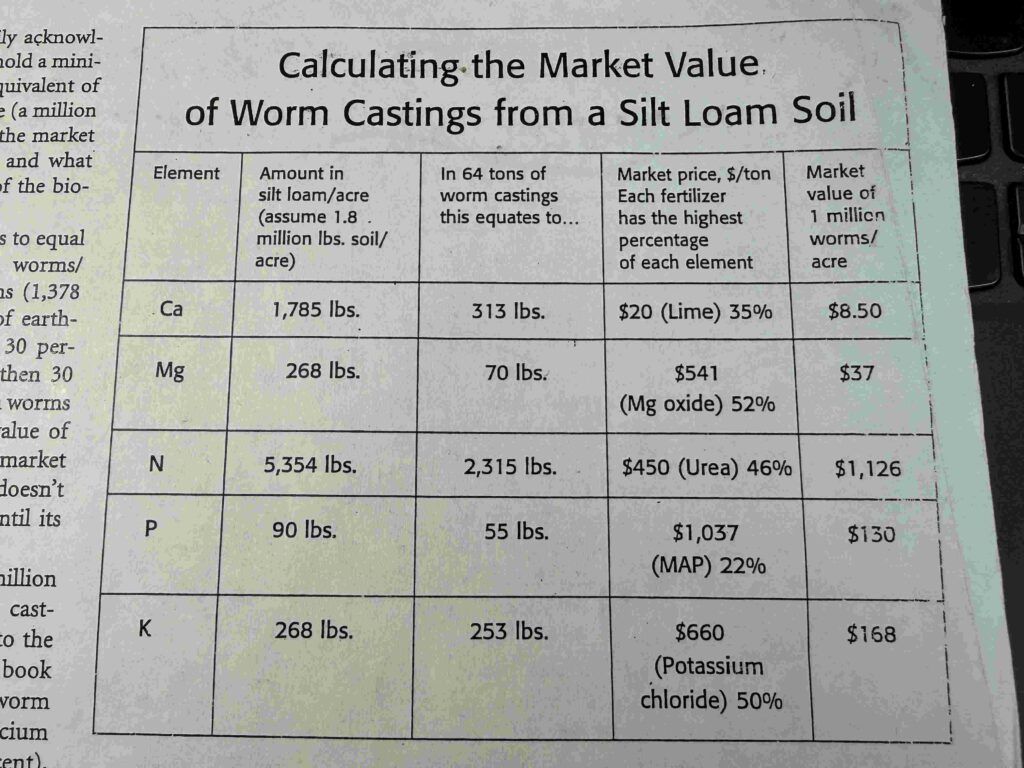
After figuring 25 worms per cubic foot of healthy soil and extrapolating that out to a million worms per acre, he figured the “market fertilizer value of these workmen were $13/acre, which doesn’t set the world on fire—until their total performance is assessed.” He calculated that one million worms would produce 70 tons of castings per year based on Barret’s findings. This one “biological asset” alone, back in 2010, according to King’s math, “created biological capital with a market value worth $594/acre because of the cumulative market value of elemental nutrients alone, and without consideration from organic matter creation and water infiltration. That’s an impressive 4,500% return!
Now, some 16 years later, a March 2026 DTN Progressive Farmer report indicates “Urea was $822.50 per ton in Illinois”. Those biological friends you can invite to your pastures with good stewardship now have almost doubled in value. Want to invest now? King also added “cash cows” and sheep into the mix of nutrient cycling, saying “excrement influences 4x the area it directly smothers, which demonstrates the highly exchangeable nutrients these animals produce and how stocking rates can influence fertility transfer for the better”.
Using AI, I asked, “What is the market value of biological capital in a pasture-based operation?” Typically measured through the lens of ecosystem services and biological assets it spit out these fun numbers to think about: “Ecosystem services are estimated at $1,043.35 per cow and improved soil health can generate an average credit of $31 to $34/ acre/yr. in combined ecosystem services”. In a 2022 report entitled: “Valuation of soil health ecosystem services”, the Vermont Soil Health and Payment for Ecosystem Services Working Group estimated that “Forage value alone accounts for about $3.8 billion of the total national biological capital in grazing systems”.
Mr. King was trying to get farmers to value their grazing management in real dollars, and reflect, in ballpark terms, real economics of biodiversity to farming systems in creating life and working with nature. He ended his 2010 sentiment by sharing, “As farmers begin measuring biological agriculture with greater professionalism, there should be a deeper connection between biological and financial capital”.
So when you’re walking your pastures this spring, think a bit deeper about your land of gold and how your management contributes to this bank account. “In his hand is the life of every creature and the breath of all mankind” ~ Job 12:7-10
John King——https://www.succession.co.nz/

 Register for the “Ultimate” Northeast NatGLC Grazing School